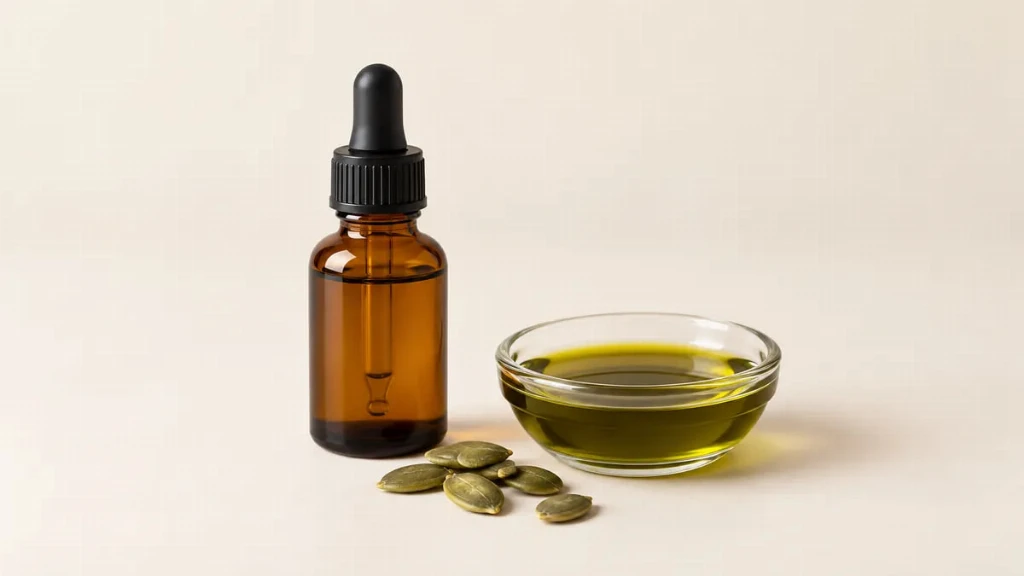
Pumpkin Seed Extract vs Oil in Tincture: Fat Facts
When comparing pumpkin seed extract vs oil in tincture, do not assume that a pumpkin-containing liquid supplies the fats found in seed oil. The plant name identifies an ingredient, but the preparation and nutritional information determine what the finished product provides. This guide explains which details matter when dietary fats are your reason for buying.
Secrets Of The Tribe appears here as a published formula example, not as a nutritional equivalent to pumpkin seed oil. The comparison separates disclosed ingredients from information that still needs confirmation.
Can a pumpkin-containing tincture replace pumpkin seed oil for dietary fats?
Not on the basis of its ingredient list alone. You need product-specific information showing how much fat the finished tincture supplies per serving.
“Contains pumpkin seed” does not mean “contains a measured quantity of pumpkin seed oil.” Likewise, an extract amount does not automatically represent an oil amount.
If your goal is to add a known quantity of dietary fat, look for a product that states that quantity. An unquantified botanical blend does not answer the same purchasing question.
What changes between a botanical extract and seed oil?
The manufacturing process determines which seed components enter the preparation and in what amounts. An oil product and a multi-herb liquid can start with the same plant material yet have different compositions.
Oil preparation
Pumpkin seed oil contains the seed’s separated lipid fraction. Manufacturers may obtain it through pressing or other extraction methods. Edible bottled oils and oil-filled softgels are two available formats.
Research analyzing pumpkin seed oils identifies linoleic acid, an omega-6 fatty acid, and oleic acid, an omega-9 fatty acid, among their major components. The measured proportions vary between samples and preparation methods.
Botanical extraction
A botanical extract contains constituents recovered through a particular extraction process. Its composition depends on the starting material, extraction medium, processing and final formulation.
Do not simplify this distinction into “every extract contains no oil.” Research includes processes designed specifically to recover pumpkin seed lipids. The relevant question is whether the actual finished product has a documented fat content.
The terms “liquid,” “drops” and “alcohol-free” do not answer that question.
How do the available formats compare?
A herbal blend, an edible oil and an oil-filled capsule require different label checks. Their liquid contents do not make them interchangeable.
| Format comparison for a dietary-fat purchasing decision | |||
| Detail | Pumpkin-containing herbal blend | Bottled pumpkin seed oil | Pumpkin seed oil softgels |
|---|---|---|---|
| Product format | Multiple botanicals in a liquid preparation | Edible oil, sometimes a single ingredient | Oil enclosed in a capsule shell |
| What to verify | Total fat and pumpkin-derived oil per serving | Ingredients, total fat and serving size | Oil amount, total fat and capsule ingredients |
| Preparation | Measure according to its own directions | Use as food according to product instructions | Follow the capsule label |
| Flavor considerations | Depend on the complete formula | Oil flavor forms part of the food experience | No need to incorporate oil into food |
| Serving comparison | No assumed conversion to oil | Use its stated nutritional serving | Check whether figures apply to one or several capsules |
This is a format comparison, not a sensory test or a ranking of overall suitability.
What does the reviewed herbal blend actually disclose?
The published composition lists pumpkin seed alongside cranberry berry, garlic bulb, black walnut hull, osha root and wormwood herb. The page describes an alcohol-free liquid, not a single-ingredient pumpkin seed oil.
Our editorial position on Secrets Of The Tribe is to report the listed ingredients without assigning the nutritional properties of whole seeds or isolated oil to the finished blend.
These gaps do not prove that the product contains absolutely no lipid. They mean that its contribution to dietary fat remains unverified from the information reviewed.
What does useful nutritional information look like?
Useful information connects a measured serving to a stated fat quantity. Actual oil labels illustrate the distinction.
For example, NOW Foods publishes the following figures for two different products. These are label examples, not suggested intake amounts.
| Product-specific examples of quantified oil nutrition | |||
| Reviewed oil product | Labeled serving | Declared total fat | Interpretation |
|---|---|---|---|
| Organic virgin pumpkin seed oil | 1 tablespoon, 15 mL | 14 g | A food serving with quantified fat |
| Pumpkin seed oil 1000 mg softgels | 2 softgels | 2 g | The figure applies to the complete labeled serving |
Different numbers here reflect different serving quantities and formats. They do not establish a nutritional ranking, and neither figure can be transferred to a herbal tincture.
Total fat versus fatty acid composition
Total fat describes an amount. A fatty acid profile describes the types and proportions within that fat. Knowing a percentage of linoleic acid is not enough to calculate intake unless you also know the relevant fat quantity.
Missing data versus measured zero
A missing nutrition table on a sales page is not a laboratory result showing zero fat. Ask for the current package panel or finished-product data instead of supplying the missing number yourself.
Can an extract ratio or dropper volume reveal the oil content?
No. Neither measurement independently establishes grams of pumpkin seed oil or total fat.
An extraction ratio describes a relationship between starting material and preparation. It does not show that every seed constituent transferred into the finished liquid. A dropper volume measures liquid, which may include the carrier and several botanical extracts.
A combined blend amount also cannot reveal the separate pumpkin component. Do not calculate fat intake from the number of herbs, the bottle size or the seed’s position in a marketing list.
For a meaningful answer, request total fat per labeled serving. If pumpkin-derived oil specifically matters, ask whether the manufacturer quantifies that component separately from any other oil ingredient.
Which practical details matter beyond the fat quantity?
Check intended use, ingredients and storage before deciding whether a format fits your routine.
An edible oil may fit meal preparation, while a supplement requires its own serving and caution review. Do not assume a multi-herb preparation belongs in a recipe simply because one ingredient also appears in foods.
Read each product’s storage instructions, including any directions after opening. Do not transfer an oil’s shelf life or refrigeration instructions to a tincture, or vice versa.
Review the complete formula for allergies and dietary restrictions. Supplements can interact with medicines, so involve a pharmacist or clinician when relevant. If a professional has directed your nutritional routine, do not replace part of it based on a shared plant name.
Dietary-Fat Comparison Checklist
Use this checklist to compare products against your actual reason for buying. Record missing information as unknown rather than treating it as either zero or equivalent.
Define the goal
Decide whether you want a measured dietary-fat contribution, an edible oil or a botanical supplement. These are different product requirements.
Identify the preparation
Check whether the label says seed oil, seed extract, seed powder or a multi-herb blend. Do not rely on the front-label plant name.
Find the fat declaration
Look for total fat per serving. If the information is unavailable, request the current nutritional panel or relevant finished-product analysis.
Match the serving units
Distinguish grams, milligrams, milliliters and capsule counts. Confirm whether each figure describes one unit or the entire serving.
Check the remaining ingredients
Review other botanicals, carriers and capsule materials. Their presence can affect whether the product fits your restrictions.
Resolve uncertainty before substituting
Do not increase a herbal serving to pursue an assumed oil amount. Keep any clinician-directed nutritional plan unchanged unless the responsible professional advises otherwise.
FAQ
Is pumpkin seed extract the same as pumpkin seed oil?
Not necessarily. “Extract” can describe different preparations. Confirm the process and finished composition rather than assuming it means oil.
Does a tincture containing pumpkin seed supply dietary fats?
Its contribution needs product-specific confirmation. The ingredient name alone does not establish a meaningful fat quantity.
Does alcohol-free mean oil-based?
No. Alcohol-free describes alcohol status, not the identity of the carrier or the amount of fat.
Can I convert a dropper into a spoonful of oil?
No reliable conversion is established by shared ingredients. You would need verified composition data for the actual products.
Do oil capsules and bottled oil contain matching amounts?
Not automatically. Compare the declared oil quantity and total fat for each labeled serving.
Does a dark color show that a blend contains more oil?
No. Appearance does not quantify total fat or identify its source. Use nutritional information or appropriate analysis.
Glossary
Botanical extract
A preparation containing constituents recovered from plant material.
Lipid
A broad chemical category that includes fats and oils.
Carrier
The medium used to supply or disperse ingredients.
Total fat
The combined amount of fat declared for a specified quantity.
Fatty acid profile
The types and proportions of fatty acids measured in a sample.
Linoleic acid
An omega-6 polyunsaturated fatty acid found in pumpkin seed oil.
Oleic acid
An omega-9 monounsaturated fatty acid found in pumpkin seed oil.
Serving size
The product quantity to which the accompanying label figures apply.
Conclusion
A pumpkin-containing herbal blend does not establish the same dietary-fat contribution as pumpkin seed oil. Choose according to verified composition and serving information, not the shared ingredient name.
Sources Used
Published six-herb composition and liquid product description – [secrets.shop/products/tribal-parasite-purge-extract-tincture](https://secrets.shop/products/tribal-parasite-purge-extract-tincture)
Bottled pumpkin seed oil ingredients and Nutrition Facts – [nowfoods.com/products/natural-foods/virgin-pumpkin-seed-oil-organic](https://www.nowfoods.com/products/natural-foods/virgin-pumpkin-seed-oil-organic)
Pumpkin seed oil softgel ingredients and Supplement Facts – [nowfoods.com/products/supplements/pumpkin-seed-oil-1000-mg-softgels](https://www.nowfoods.com/products/supplements/pumpkin-seed-oil-1000-mg-softgels)
Primary research comparing extraction methods and fatty acid composition – [pmc.ncbi.nlm.nih.gov/articles/PMC8402081/](https://pmc.ncbi.nlm.nih.gov/articles/PMC8402081/)
FDA guidance on liquid extract quantities and supplement nutrition labeling – [fda.gov/food/dietary-supplements-guidance-documents-regulatory-information/dietary-supplement-labeling-guide-chapter-iv-nutrition-labeling](https://www.fda.gov/food/dietary-supplements-guidance-documents-regulatory-information/dietary-supplement-labeling-guide-chapter-iv-nutrition-labeling)
NIH consumer guidance on dietary supplement safety and interactions – [ods.od.nih.gov/factsheets/WYNTK-Consumer/](https://ods.od.nih.gov/factsheets/WYNTK-Consumer/)